

Pre-Calculus Handwritten Reviewers on Functions and Notations

❤️ Reference Acknowledgments:
Cutrone, J. W. (2021). Precalculus: Relations and functions [MOOC]. Johns Hopkins University; Coursera. https://www.coursera.org/learn/precalculus-relations-functions
Introduction
In early 2025, I went back to basics with Johns Hopkins University's Precalculus course on Coursera. I wanted my foundations to be really solid before moving on to harder maths, so I did what I always do: grabbed my red, green and blue pens and wrote everything out by hand.
You'll see a start and end time in the corner of almost every sheet. I time my study sessions because it keeps me focused, and honestly, I like knowing how long things actually take me. The quadratic formula sheet alone took me 1 hour and 14 minutes, haha.
These are my handwritten reviewers from one week of studying, from 30 January to 6 February 2025. Under each photo, I typed up the key ideas so they're easier to read, search and copy.
I colour-code my notes, so I colour-coded this page too: the 🔑 boxes have the key ideas, and the 🚨 boxes are traps to watch out for.
📚 What's inside
1. 🗺️ The Big Picture: Different Types of Functions
I like to start with a map before going into the details. On this sheet, I put every function family side by side: linear, quadratic, cubic, square root, reciprocal, piecewise, exponential and logarithmic. For each one, I wrote the formula, the domain and range, and a quick sketch of the graph.
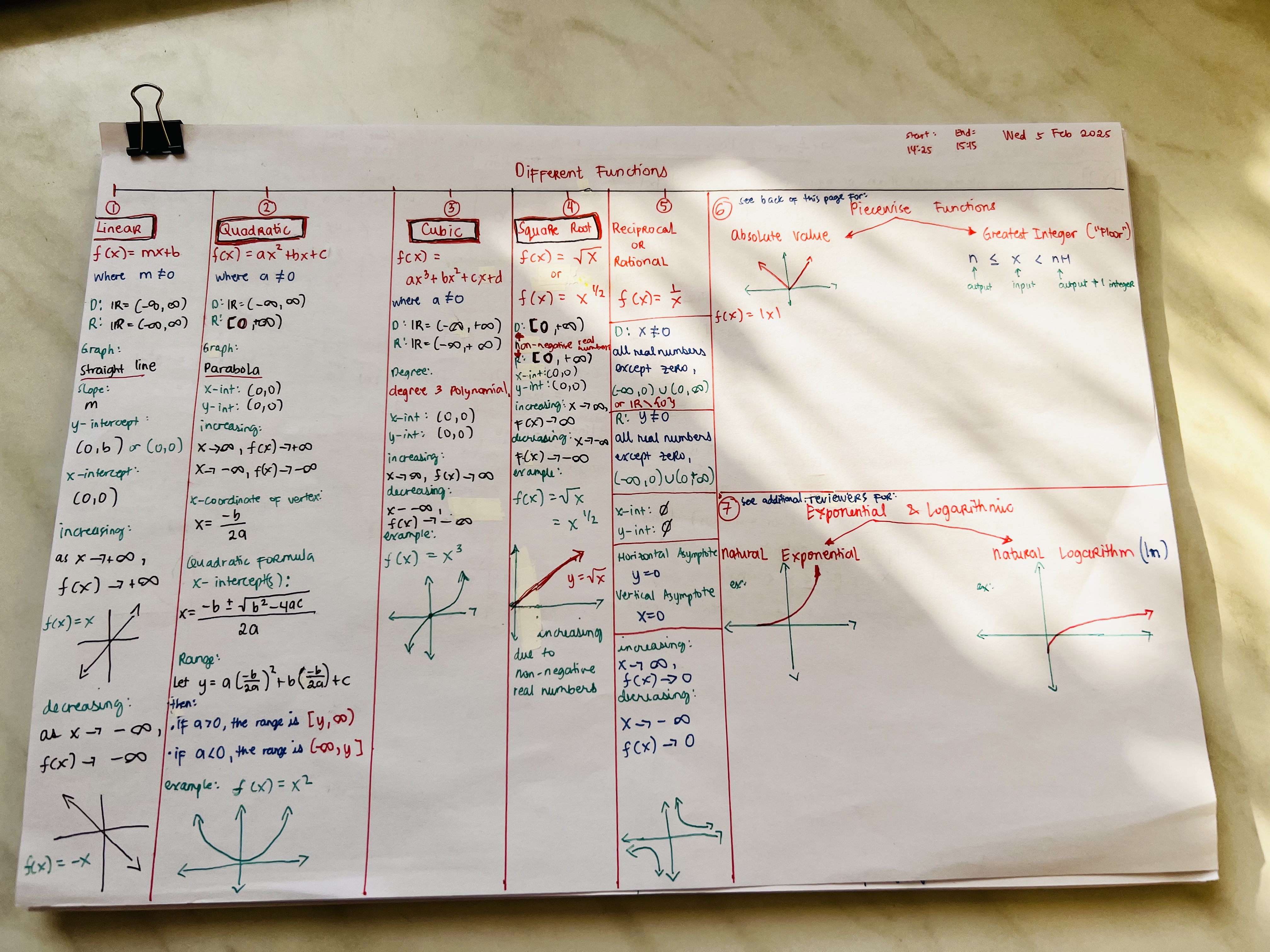
Here is the same map as a table:
| Function | Formula | Domain | Range |
|---|---|---|---|
| Linear | |||
| Quadratic | depends on the vertex, | ||
| Cubic | |||
| Square root | |||
| Reciprocal | |||
| Absolute value | |||
| Greatest integer | all integers, | ||
| Exponential | |||
| Logarithmic |
The reciprocal function
2. 📈 Exponential Functions
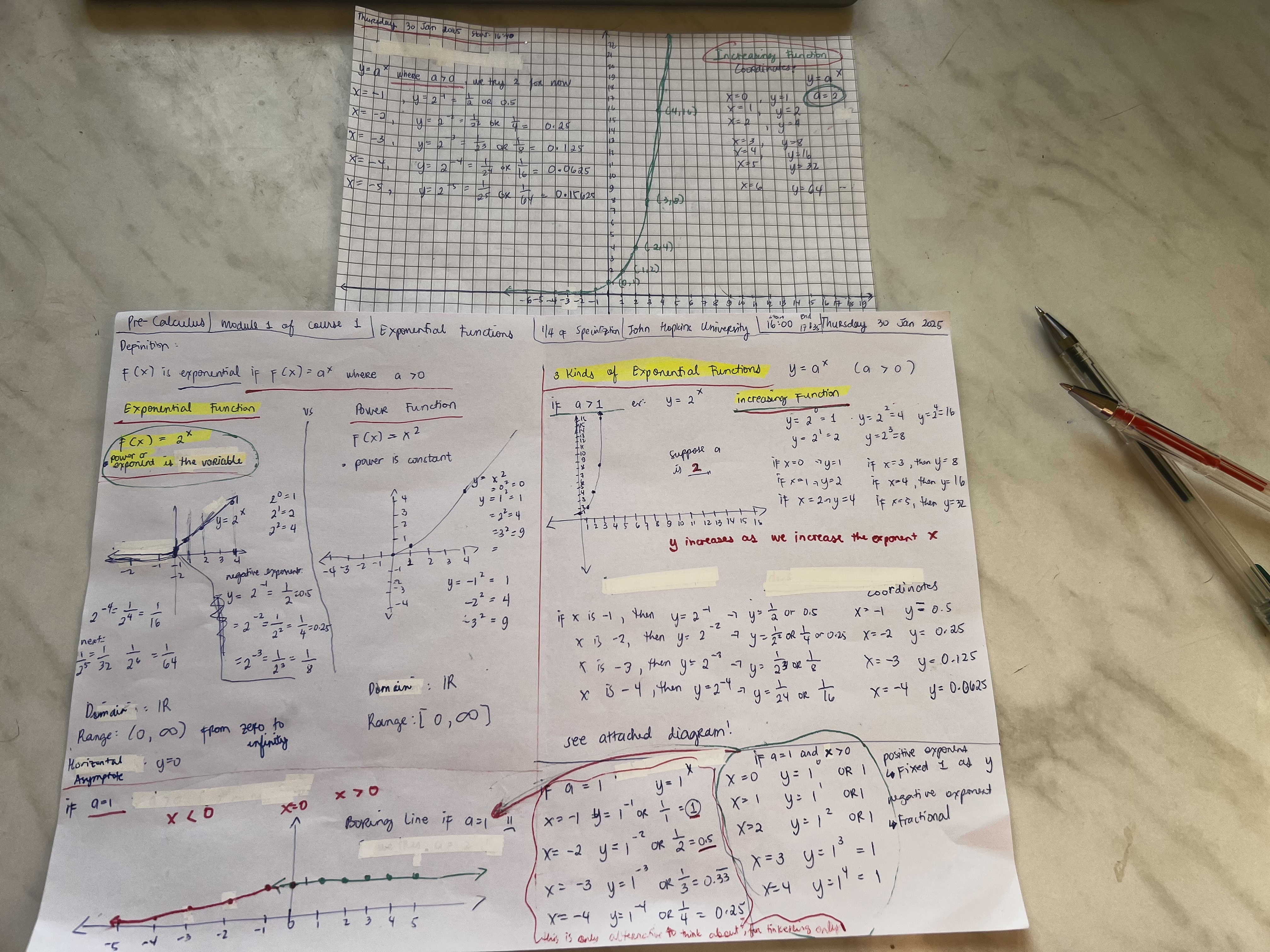
This is my earliest sheet here, from 30 January. A function is exponential if
The first thing that clicked for me was the difference between a power function and an exponential function:
- In a power function like
, the power is fixed and is the base. - In an exponential function like
, the base is fixed and is the exponent.
I also plotted
🔑 Three kinds of exponential functions
: increasing, like . grows as grows. : decreasing, like . : just a flat line at . On my sheet, I literally wrote "Boring line if " 😂
For all of them, the domain is
3. 🪜 Logarithmic Functions and Rules
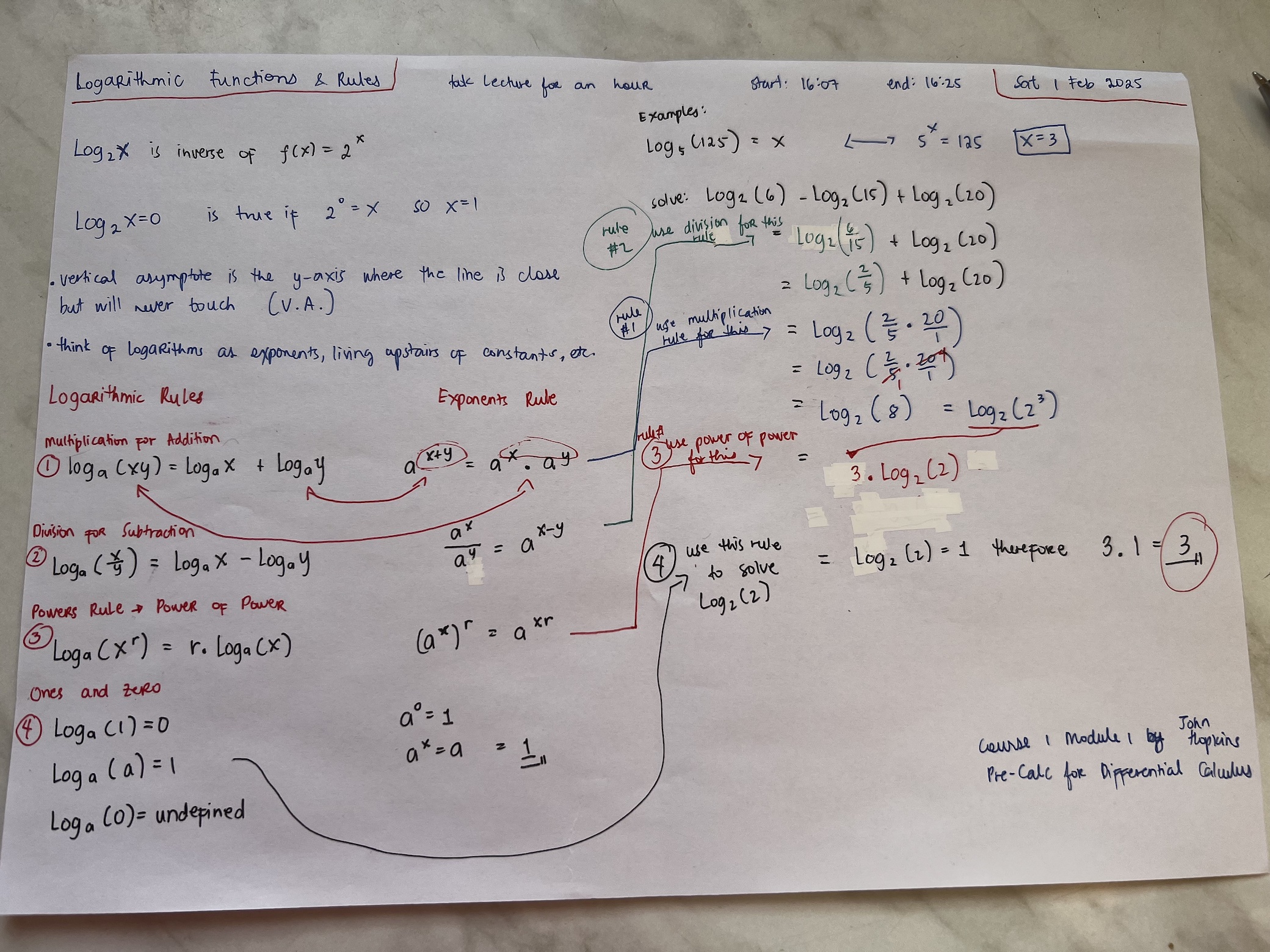
On 1 February, I watched the lecture for an hour and then made this sheet. The way I remember logarithms: think of them as exponents living upstairs.
The trick that helped me most was pairing each logarithm rule with the exponent rule it comes from:
🔑 The four logarithm rules
| # | Logarithm rule | Comes from the exponent rule |
|---|---|---|
| 1 | ||
| 2 | ||
| 3 | ||
| 4 |
And
Then I used all four rules in one problem:
4. ✏️ Practising Logarithms and Roots
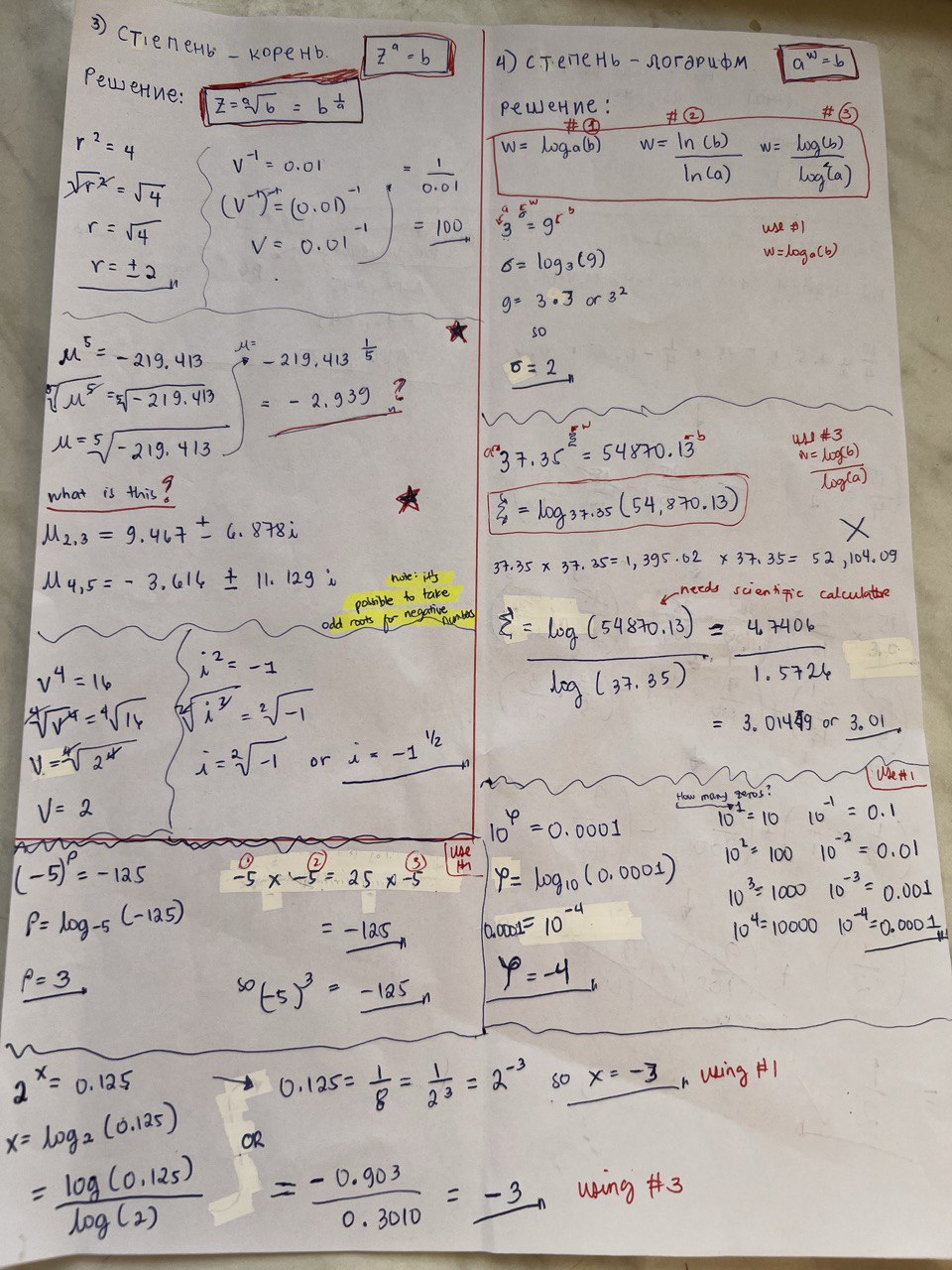
This sheet is all practice, and it's built around two types of problems:
- The unknown is the base, like
. Solve it with a root. - The unknown is the exponent, like
. Solve it with a logarithm.
🔑 Three ways to find the exponent
The second and third ones are the change of base formula, and they're what you type into a calculator.
Some of my favourite examples from this sheet:
, so , so , so . I also checked it with the calculator: , which really needs a scientific calculator:
And for the root problems:
, so , so , so . I highlighted this one, because I learned that you can take odd roots of negative numbers!
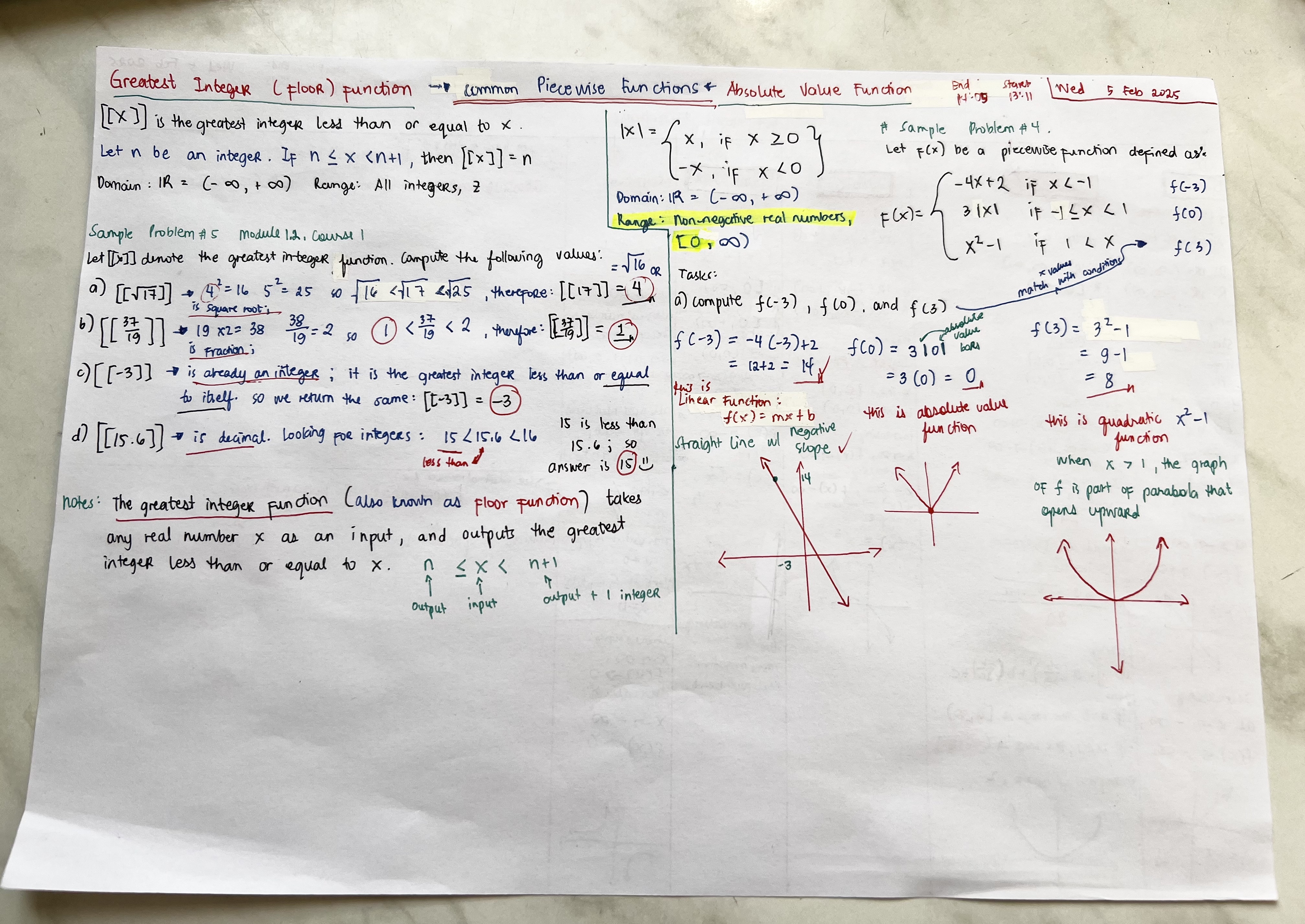
5. 🧩 Piecewise Functions: Absolute Value and Greatest Integer
A piecewise function uses different formulas for different parts of its domain. The two most common ones are the absolute value function and the greatest integer function.
Absolute value:
Its domain is all real numbers, and its range is
Greatest integer (also called the floor function):
My sample problems:
, because and , so , because , because it is already an integer , because . I drew a little smiley here 😄
Then a full piecewise function:
The trick is to match each x value with its condition first, then use that formula:
, using the linear piece , using the absolute value piece , using the quadratic piece
🚨 Trap: negative decimals
Be careful with negative decimals! math.floor() does in Python.
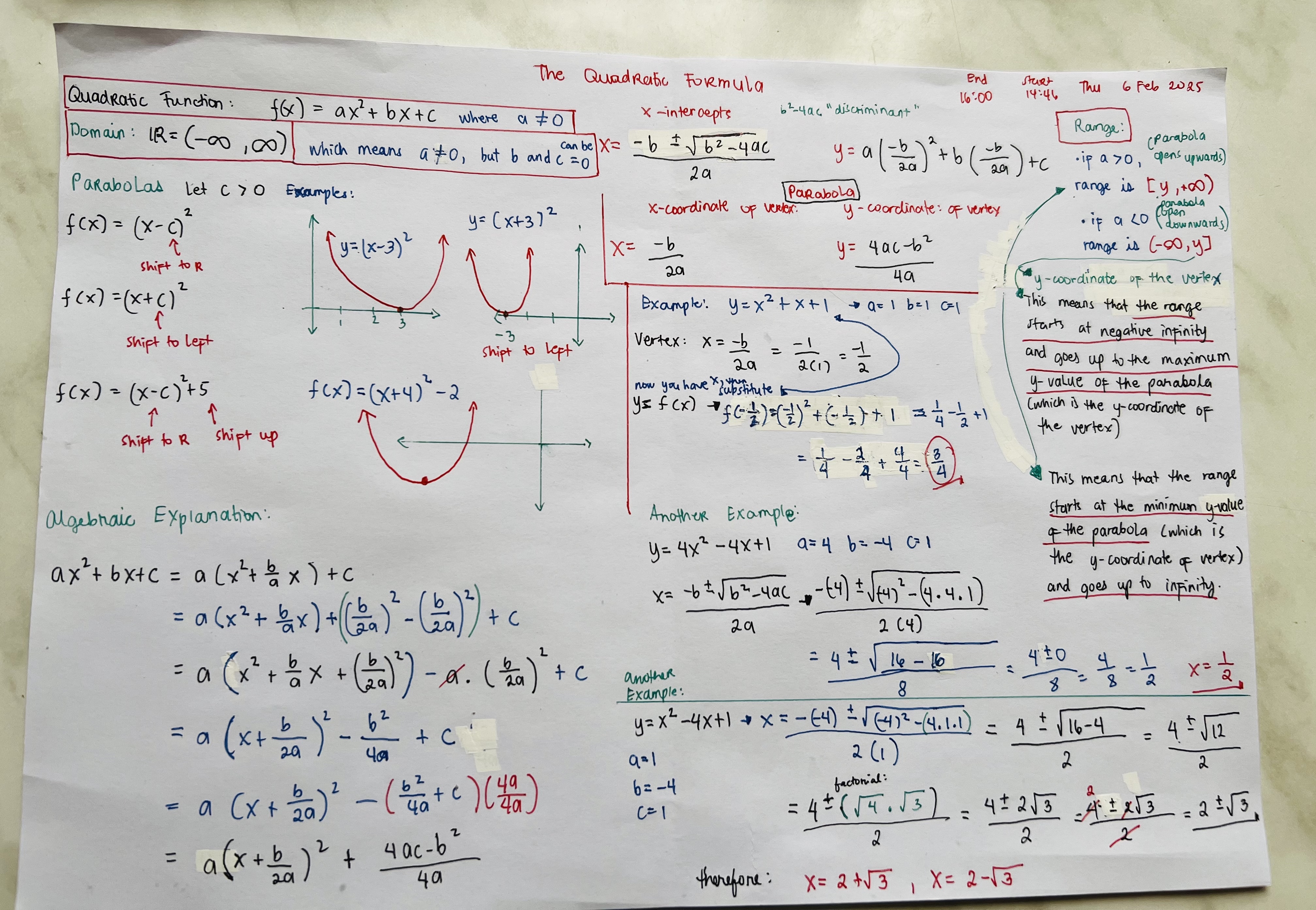
6. 🌈 Quadratic Functions and the Quadratic Formula
A quadratic function is
Shifting parabolas, with
shifts the parabola to the right shifts it to the left shifts it to the right and up
🔑 The vertex and the range
If
I also worked through where the quadratic formula comes from, by completing the square:
And here is the formula itself. The part under the square root,
My examples:
: the vertex is at , and : . The discriminant is 0, so there is only one answer. :
7. 📏 Domain, Range and Interval Notation
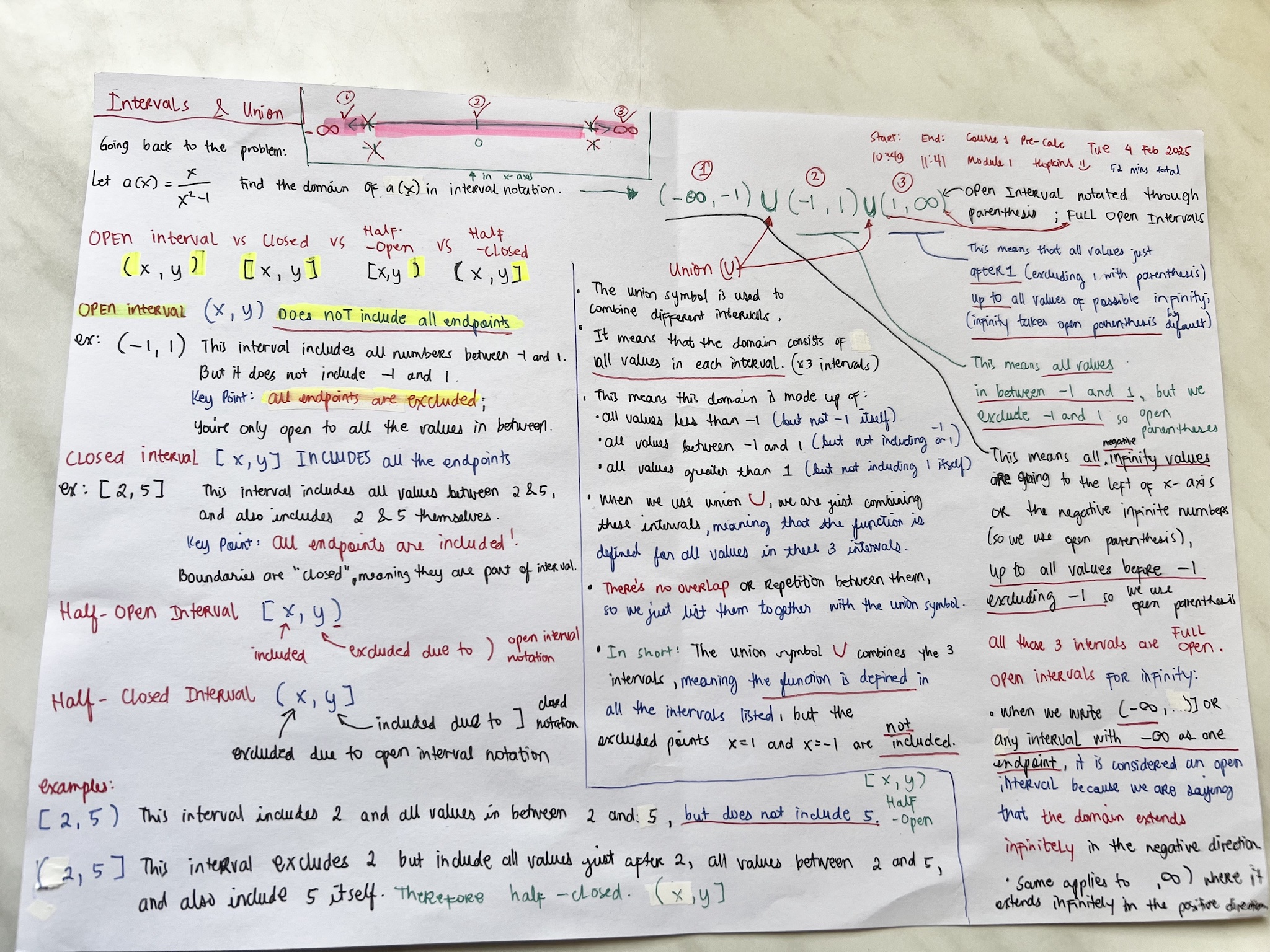
This topic took me two days, 3 and 4 February. First, the four types of intervals:
| Type | Notation | Includes the endpoints? | Example |
|---|---|---|---|
| Open | neither | ||
| Closed | both | ||
| Half-open | only | ||
| Half-closed | only |
Infinity always takes a round bracket, like
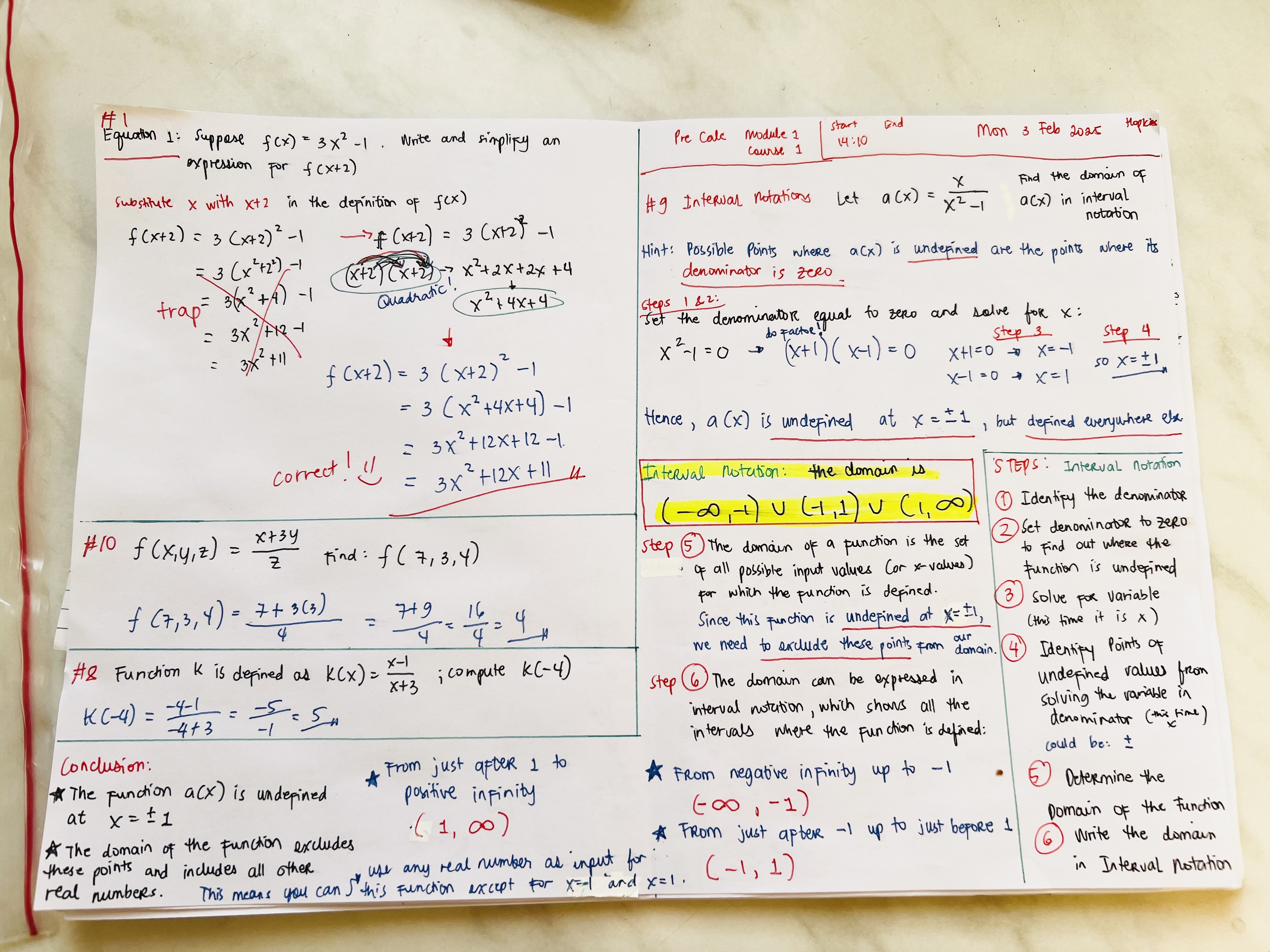
🔑 My 6 steps for finding the domain of a fraction
- Identify the denominator.
- Set the denominator equal to zero, to find where the function is undefined.
- Solve for the variable.
- Note the points where the function is undefined.
- Determine the domain: all real numbers except those points.
- Write the domain in interval notation.
Example: for
Another example: for
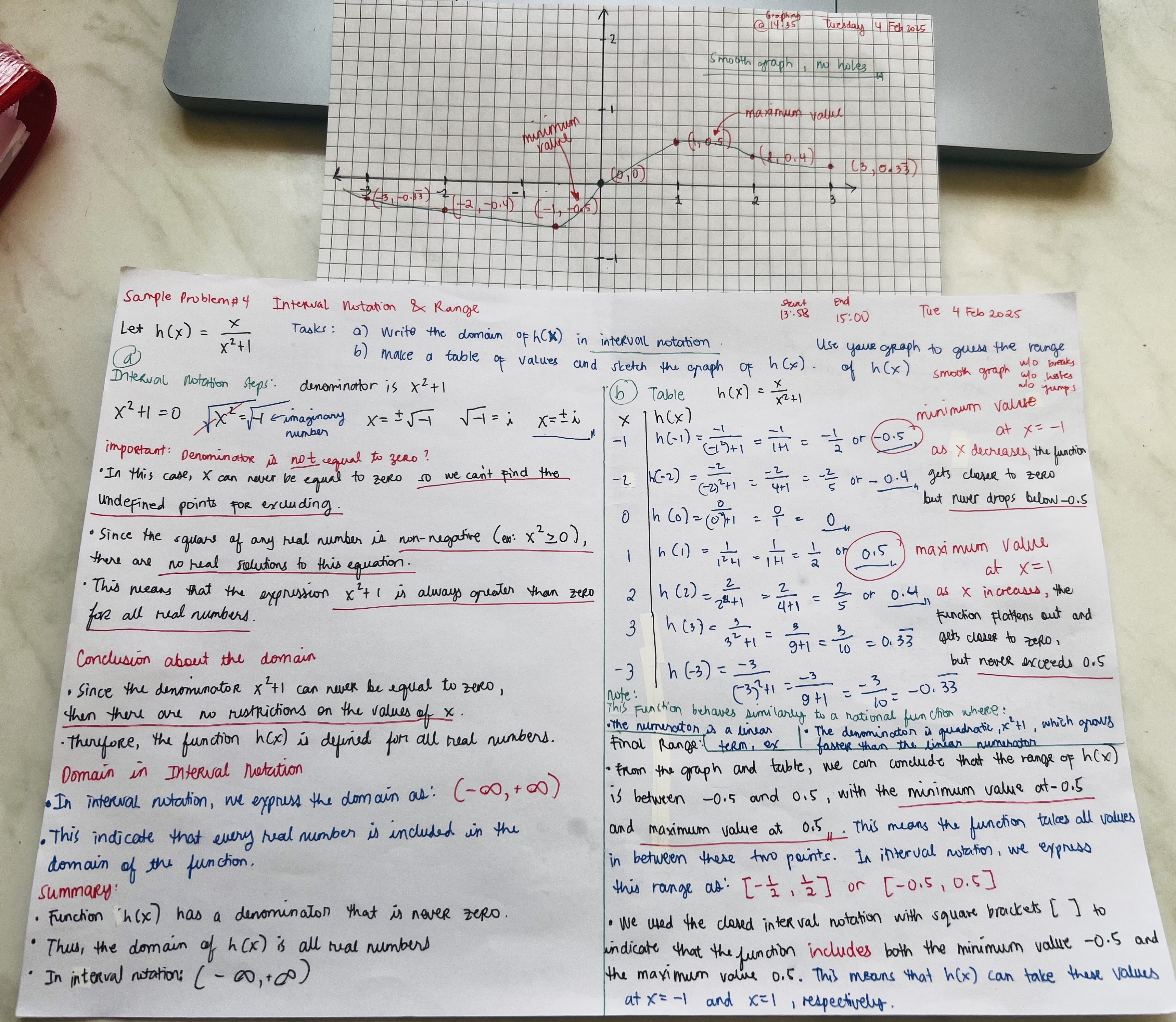
To find the range of
🚨 My favourite trap that week
For
💖 Final Thoughts
That was one week and a lot of ink. 😂 If you're starting pre-calculus too, my biggest tip is to write it out by hand, use colours for different ideas, and time yourself. It's surprisingly motivating to see your progress on paper.
If you want the typed-up versions with code, check out my Algebra Formulas in LaTeX, Python and Rust and my chapter on exponents. More handwritten reviewers will be added soon! ❤️